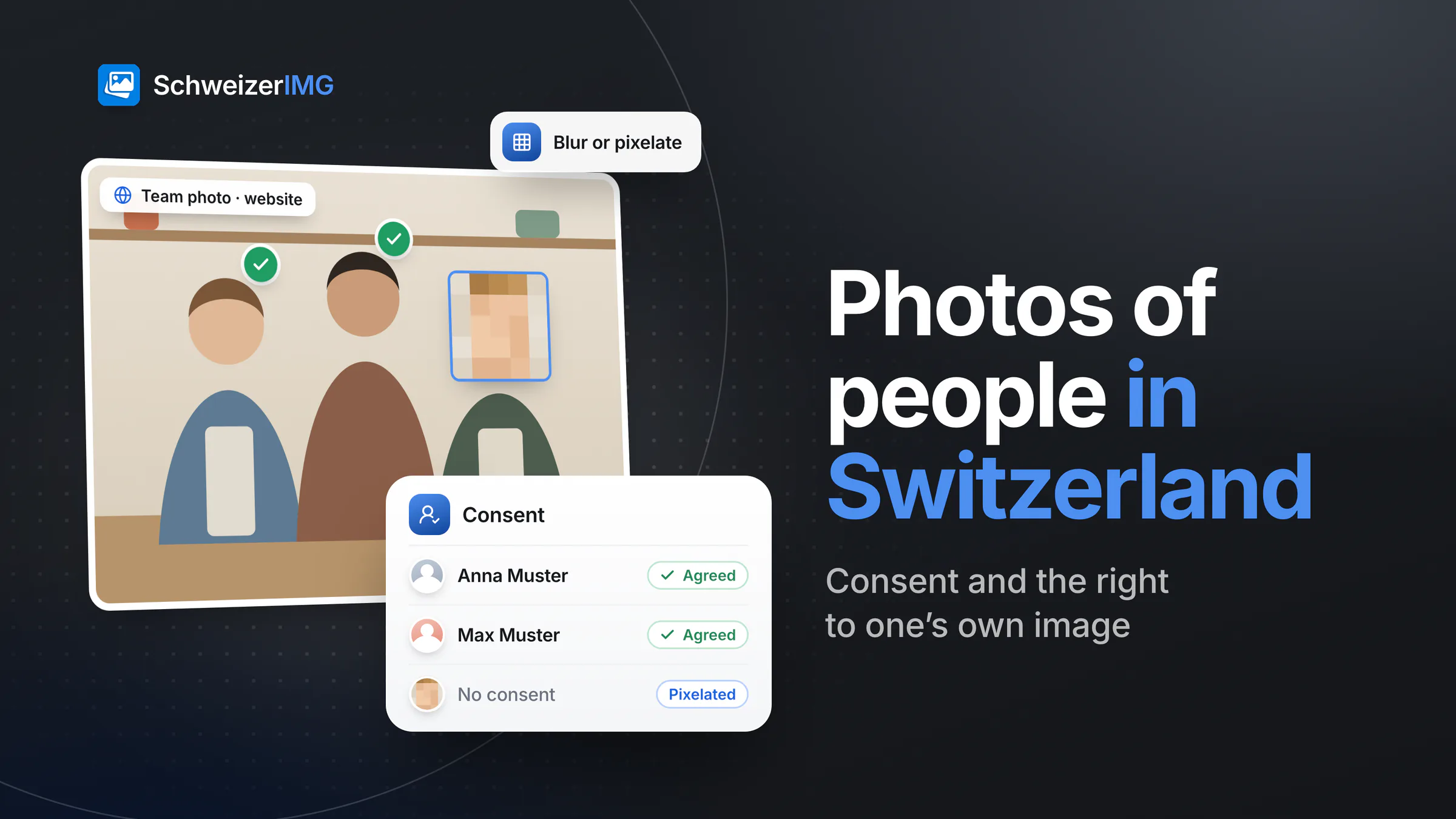
In Switzerland, people who can be recognised in a photo generally decide for themselves whether and how it is published. Consent is the rule; publishing without it needs another justification, such as an overriding interest, and that is assumed only with restraint — especially for photos of individuals.
This article explains where the right to one's own image comes from, when the Swiss Federal Act on Data Protection (FADP / nDSG) applies to photos, how consent is commonly handled for team photos, events and children, and what you can do when consent is missing: choose another picture, crop, or make people unrecognisable before you publish.
The right to one's own image in Swiss law
Swiss law has no single article titled "right to one's own image". It is part of the protection of personality in Art. 28 of the Civil Code: a person whose personality rights are unlawfully infringed can turn to the court, and an infringement is unlawful unless it is justified by the person's consent, by an overriding private or public interest, or by law. Courts and legal writing have long counted a person's image among these personality rights.
In practice this means three possible grounds for publishing a recognisable photo: consent, an overriding interest (for example reporting on an important public event) or a legal basis. For a company website, a newsletter or a social media post, consent is usually the ground that matters.
When photos are personal data under the FADP
The Federal Act on Data Protection applies to personal data — any information relating to an identified or identifiable person (Art. 5 lit. a). A photo in which someone can be recognised falls under it as soon as a business or organisation takes, stores or publishes it. The principles of Art. 6 then apply: a recognisable purpose, proportionality, and where consent is required, consent given voluntarily and based on appropriate information. Processing by a private individual exclusively for personal use is outside the Act (Art. 2 para. 2 lit. a).
Biometric data is a separate category. The FADP counts biometric data that uniquely identifies a person as sensitive personal data (Art. 5 lit. c no. 4). An ordinary photo is generally not seen as biometric data in itself; the question typically arises when photos are processed with specific technical means, for example to create face templates for recognition. Publishing a team photo on a website is a different situation.
The file itself can also say more than the picture: GPS location, capture time and device details are stored in its metadata. How to see and remove them is described in what your photos reveal.
Consent in practice: employees, events, children
The Federal Data Protection and Information Commissioner (FDPIC) explains the principles for taking and publishing photos on its page about photos and privacy. The following overview combines them with common practice and summarises typical situations in general terms:
| Situation | What is commonly recommended |
|---|---|
| Employees on the website | Ask each person, explain where the photo appears (website, brochure, social media), and get the consent in writing so it can be shown later. Consent must be voluntary — make clear that saying no has no consequences. Remove the photo when it is withdrawn or the person leaves. |
| Event participants | Announce before the event that photos are taken and where they are published. For group photos, informing people is generally considered enough; objections must be respected. For photos that focus on one person, that person should see the picture and know the context. |
| Children and young people | Parents or guardians should also agree before a photo of a minor is published. Young people who can judge the matter themselves have their own say as well. |
| Customers and references | Ask before publishing, also for a "happy customer" picture taken in your shop or at their home. |
| Archive photos | An old consent may not cover a new use. Find out who is in an older photo before you reuse it, then ask. |
Good consent says who agrees, which photos, where they appear and for how long, and how it can be withdrawn. Consent can generally be withdrawn at any time; publication should stop from that point, even if printed material can then no longer be used.
Public events, crowds and bystanders
Crowds are where the questions start, and there is no simple rule. According to the FDPIC, people who appear only incidentally in a photo taken openly in public — passers-by in front of a landmark — do not have to be approached; the photo should be deleted or not published if they ask, at the time or later. Reporting on a major public event such as a concert or a sports match can be an overriding interest. A crowd photo in which one person stands out, or a picture that shows someone in an embarrassing or sensitive context, is assessed differently.
The FDPIC also notes that an infringement can only be ruled out with certainty when the people pictured cannot be identified — for instance because the image is small or its resolution so reduced that faces and other features are no longer recognisable. When in doubt, ask for consent first.
When consent is missing: don't publish, crop or make unrecognisable
If you cannot get consent for a person who is clearly recognisable, you have three options. Often the simplest is a different photo. Otherwise:
- 1
Crop the person out
If someone stands at the edge of the frame, Crop removes them completely. Nothing of them remains in the exported file.
- 2
Make them unrecognisable
In Blur or pixelate, draw a box over each face and add it as a rectangle or an ellipse. Choose a strong setting: from a strength of 70, blur is pixelated first; Solid colour covers the area completely. Also hide name badges, distinctive tattoos and reflections.
- 3
Check at 100 % zoom
Open the result at full size. If you can still guess who it is — from hair, clothing or the context — make the area larger or the setting stronger.
- 4
Remove the metadata
Blur or pixelate removes metadata by default and always drops embedded previews, which could show the unedited picture. If you kept the metadata, run Remove metadata before publishing: the location in the file can identify a place, and with it the people.
Irreversible in the exported file
In the exported image, the hidden pixels are replaced and cannot be recovered. Your original stays unchanged on your disk — store it carefully or delete it. Making a face unrecognisable reduces identifiability; it does not replace consent where the context still reveals who it is.
How the tool works step by step is described in blur faces and number plates and, for the file data, in remove location and camera data; the whole workflow with the right settings is in blur faces and number plates in photos. Blur or pixelate and Crop are listed among the editing tools.
Why these photos should stay on your device
The photos that need this care are exactly the ones you shouldn't hand to a stranger: unpublished pictures of colleagues, children at a club event, guests who haven't agreed yet. SchweizerIMG processes images in your browser; they are never sent to or stored by us, and per run our server receives only the tool and the outcome. Details are on the security page; the difference to upload-based image websites is explained in browser image tools vs. upload websites.
Frequently asked questions
Does consent to publish a photo have to be in writing?
Swiss law generally does not prescribe a form for this consent, but you may have to show later that it was given. The FDPIC advises written consent for commercial use. A short form that names the photos, the channels and how to withdraw is common practice.
Can a former employee ask us to remove their photo?
Consent can generally be withdrawn at any time, and publication should stop from then on. Many organisations remove staff photos from the website when people leave, without waiting to be asked.
Is blurring a face always enough?
Not always. A person can be recognised by their figure, clothing, a name badge, the place or the caption. Look at the whole picture and the text around it, use strong settings, and choose another photo if the person stays identifiable.
Do these rules apply to photos in a private family chat?
The FADP does not apply to processing by a private individual exclusively for personal use. The right to one's own image under the Civil Code still protects the people pictured, and a photo posted publicly is a different situation from one shared within the family.
Which plans include Blur or pixelate, Crop and Remove metadata is shown on the pricing page. To try the tools on your own photos, create an account.
General information
This page is general information and marketing content, not legal advice. It simplifies the right to one's own image under the Civil Code and the Swiss Federal Act on Data Protection (FADP / nDSG), and summarises the FDPIC's guidance in general terms; whether a specific photo may be published depends on the circumstances. For a decision about your own situation, please consult a qualified professional.